






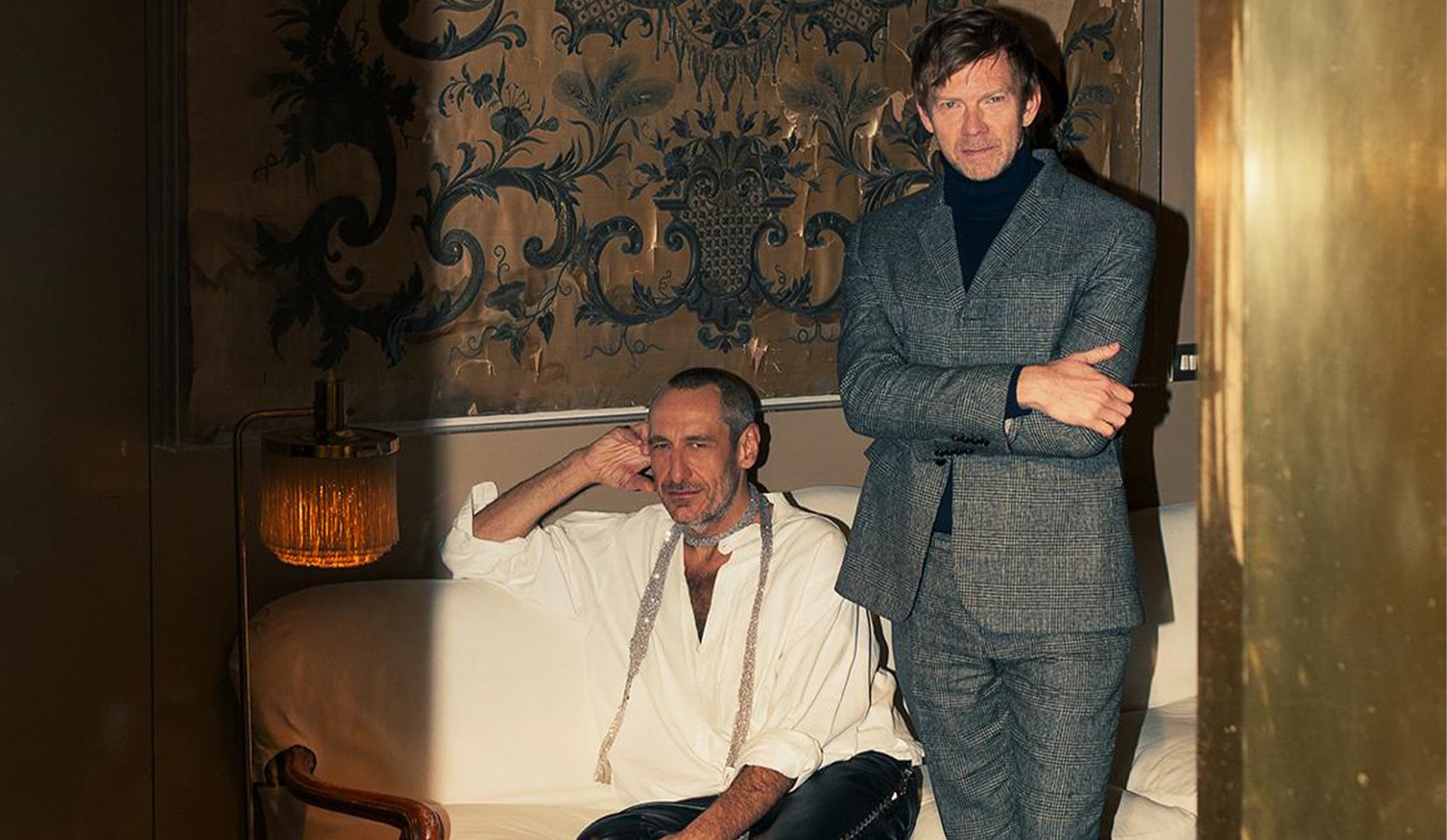
The Milan-based design duo Dimore studio is known for spaces that feel suspended between eras. Britt Moran and Emiliano Salci have spent decades pairing nostalgia with possibility, artisanal techniques with contemporary vision. Old and new. Vintage and present. A materialization of passion. We got the chance to sit down with them. Here is what they revealed.
You speak about the power of a nostalgic approach to a project to give it some roots, and then inject it with more of a contemporary feel. Do you have a go-to rule to make sure you always end up with a balanced space?
We don’t really follow a rule, rules tend to flatten things. Nostalgia gives us a structure, almost like a script, but then we interrupt it. The balance comes from tension: something familiar, something slightly off. If it feels too resolved, we know we’ve gone too far.
One thing you’ll always fight for with a client.
Atmosphere. Always. Clients may focus on objects, but we fight for the feeling of the space: light, proportions. Without that, everything else is decoration.
Weirdest thing you had to compromise on in a project.
Once we were asked to remove a perfectly placed door because it was considered “unnecessary.” It disrupted the entire spatial sequence and the intended perspective, but at times compromise is part of the process. In those cases, we try to re-establish balance and rhythm elsewhere, shifting the narrative through other spatial gestures.
What’s the last detail you obsess over before you call it “done”?
The final stage is almost immaterial. It is less about addition than calibration of objects, light, and details.
Biggest design ick in 2026?
Forced coherence. Spaces over-polished into a single, seamless narrative where materials, tones, and references all align too perfectly. When everything matches, nothing breathes. More relevant now is a softer coherence, where small dissonances are allowed to stay, keeping the space alive and unresolved.
Do you start with colour, texture, or something else?
Never colour first. We usually start with a narrative or an image, sometimes a film, sometimes a memory. Materials and colours arrive later, almost as a consequence.
Best era to get design inspo from? (30s, 70s, etc.)
We don’t believe in a single era. The 30s have discipline, the 70s have freedom but the most interesting spaces happen when these moments collide without hierarchy.
Most underrated material used right now?
Lacquer, when used with restraint. It has a depth that people often underestimate today.
Most overrated material used right now?
Travertine, perhaps. It’s everywhere, often without intention.
Design rule you love breaking (and why you get away with it).
Symmetry. We like to break it subtly, shift something by a few centimeters. The eye doesn’t immediately register it, but the space becomes more alive.
One thing you’ve seen someone try to copy from you but get wrong.
The idea of layering without contrast. What is often imitated is the accumulation of references, but not the underlying tension that gives it meaning. Our work is frequently reduced to surface, yet what is harder to replicate is the precision of our use of codes—the way we deliberately mix and reinterpret visual and cultural references, creating unexpected yet controlled juxtapositions between materials, eras, and languages. Equally essential is our notion of patina: not as an applied effect, but as an atmosphere of time, depth, and lived-in presence. Without this internal logic, everything becomes merely decorative, losing its quiet complexity and resonance.
Favourite project?
It’s always the one we’re working on. Once a project is finished, it belongs to someone else.
Your rooms feel like a film still. Do you have a genre you always secretly design for?
Probably a psychological drama. There’s always a sense that something has just happened, or is about to.
You do “layering” differently…what’s one layer people skip that changes everything?
Time. Not in a literal sense, but as a perception, how old something feels next to something new. That invisible layer changes everything.
What should never be matched in a room?
Too much harmony. We prefer when objects resist each other a little, that’s where character begins.
What’s your relationship with trends? Ignore or reinterpret?
We don’t ignore trends, but we don’t follow them either. We absorb them, distort them, and sometimes slow them down.
Finish this sentence: “A Dimore space should feel like…”
A place that feels instantly familiar, yet never fully knowable, where memory is evoked rather than described, and where time seems gently suspended.

SHARE
